Bruno the dog
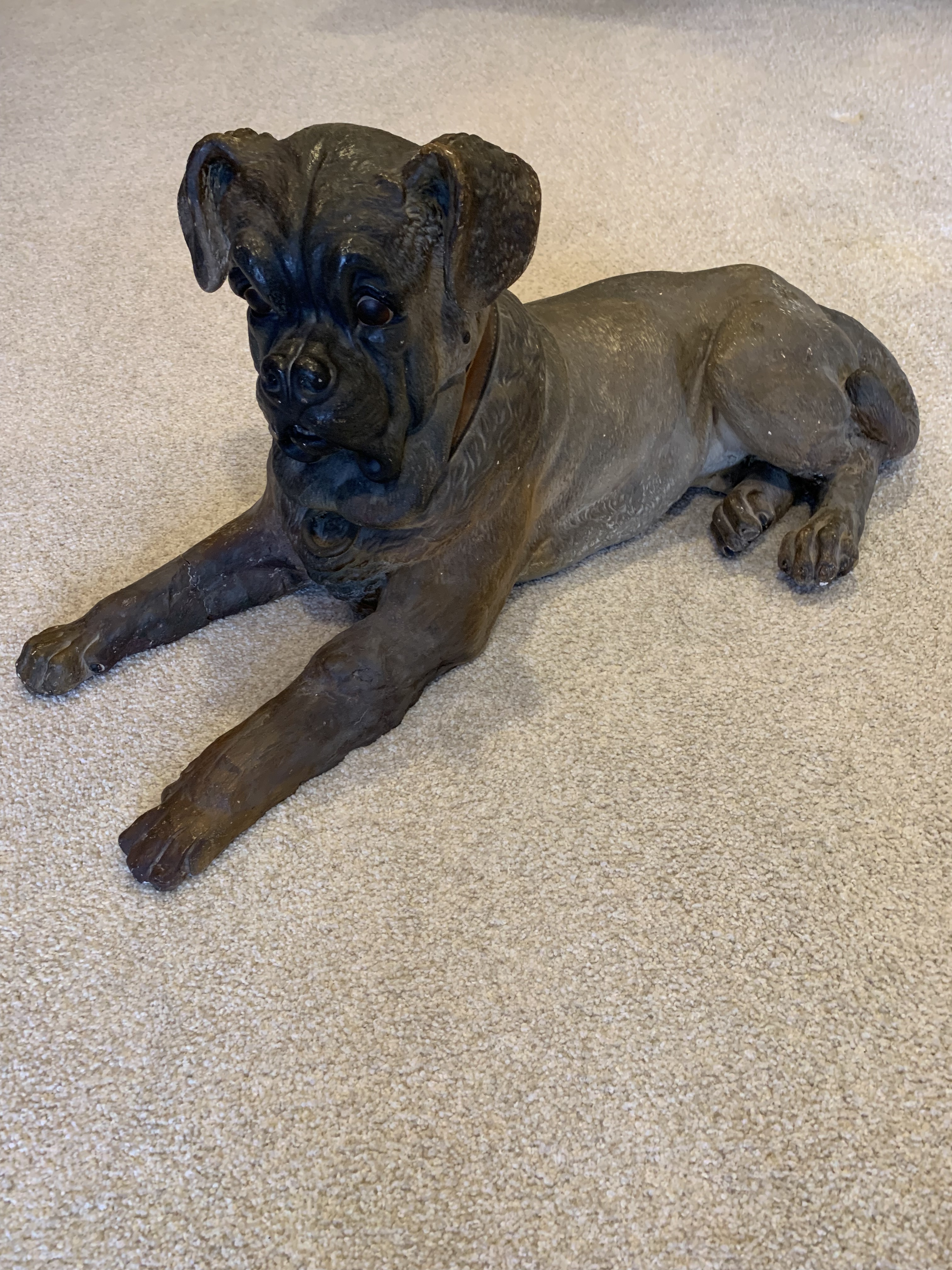
He is a full sized replica of a Bull dog made out of plaster of Paris. I remember sitting on him as a child in my grandparents house. He has been repaired by my grandmother and myself over the past years. Henry Wolfhard carried Bruno from his Hardware store on King Street in around 1905 to his home on Albert Street for a gift to his son, Harry.
Inlaid Wrought Iron Table

I recall the story from my grandmother when she gave us this unique cast iron and tiled table. When my Grandfather Harry was the manager of Merchant’s Rubber in the 1920s, he struck up a friendship with the Sam Levene in Kitchener. Levene’s tool and die company was getting established and Harry was having them provide tooling for Merchants footwear. They became friends and one day, the Levenes were visiting my grandfather and saw a flimsy table they had. Levene’s delivered a heavy, robust table the company made as a gift to their friends, Harry and Duretta. My father Bill was friends with Martin Levene and I with Gary who we all played badminton.
Homer Watson Painting
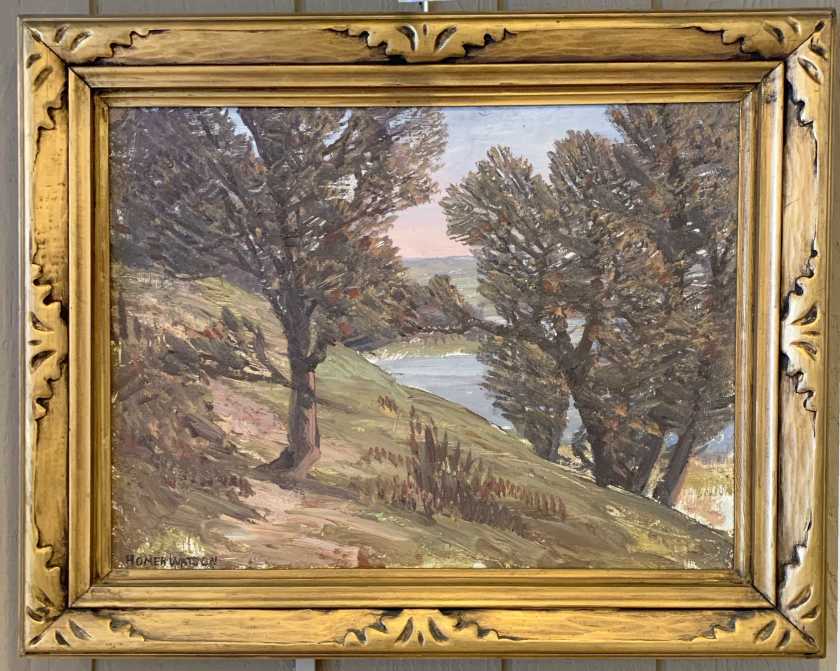
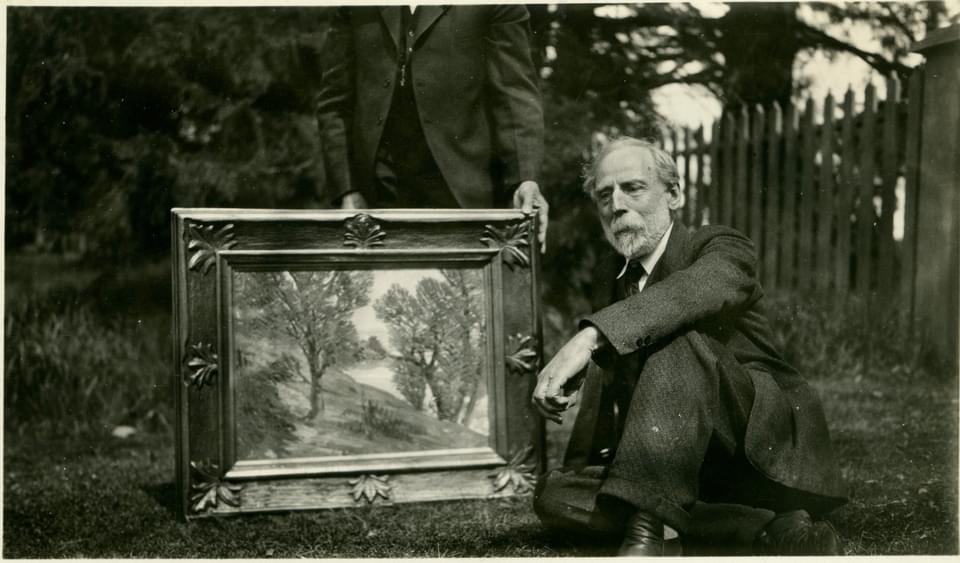
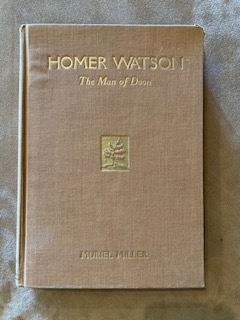
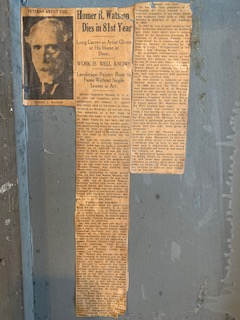
My grandparents purchased the framed painting called ‘Banks Along the Grand’ directly from Homer Watson in 1935 shortly before Homer’s death. He painted it in 1929 and the location was in Cressman’s Bush, now called Homer Watson Park, near his residence. They paid $150.00. A newspaper clipping of Homer’s obituary is taped to the back of the painting. Apparently Homer’s son in law made the frame and is similar to other Homer Watson framed paintings. Along with the painting, we have a signed copy of a book written by Muriel Miller which lists the painting with my grandfather the owner.
In 2008, the painting was appraised for $8000.00
Born in 1855, Watson was recognized as one of the first artists to portray the Canadian landscape without European influences. Combining elements of romanticism and realism, his landscapes reflected early pioneer life and the physical nature of Canada.
Photo above-Homer Watson with painting, c. 1931, Homer Watson House Foundation Permanent Collection.
Banjo Clock 1924
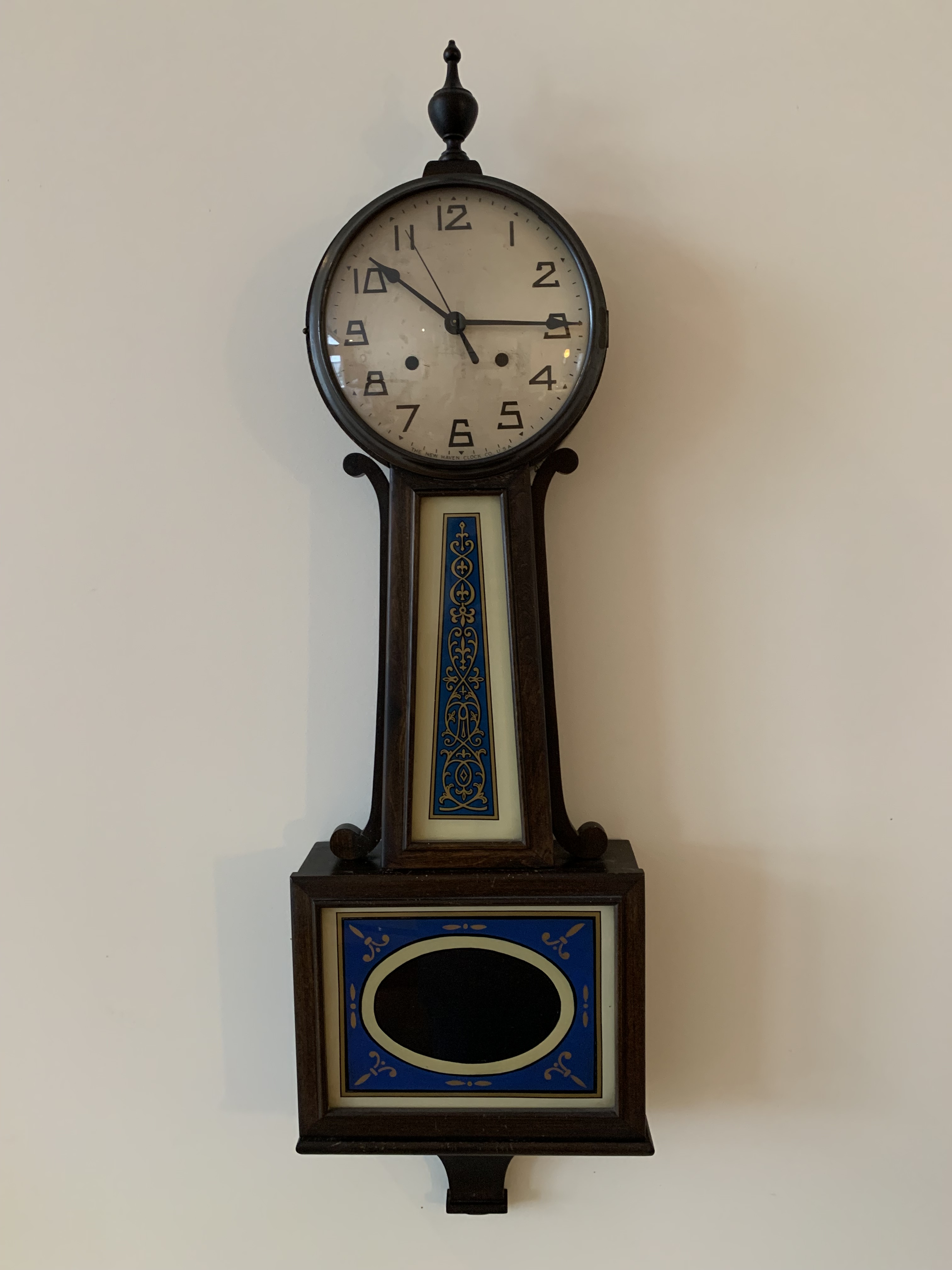
This clock hung in my grandparent’s basement and had the original clock mechanism that needed to be wound daily. It chimed on the hour and half hour. At 12 o’clock it would chime loudly 12 times. When my grandmother sold her house my father spoke up for it for me. At that time, the mechanism was broken and I took it to antique clock repair shop in Creemore, Ontario. The clock worked for a few weeks, broke again and couldn’t be repaired. I re-worked it with an inexpensive battery operated works. The clock has very little value. I researched and found the same clocks at auction for a few hundred dollars. They were slightly different as the lower glass front had a different picture. On close examination, it appears Duretta replaced the glass and hand painted it herself.
Bluenose Schooner model 1924

My grandfather bought this model from a carver in Lunenburg, Nova Scotia in 1924 and brought it home to Elmira on his lap on the train. The original Bluenose was built in Lunenburg in 1921. I remember the model over the fireplace at my grandparent’s cottage and then later at my parents house. Over the years, pieces broke or went missing and the fine linen sails rotted. When I retired, I took on the task to refurbish it. I repainted it, got the wheel and rudder working and re-rigged it. I couldn’t repair the sails so I rigged the boat with the sails folded and furled as if being tied to a dock. What’s interesting, is in it’s day, the lines and halyards worked through the blocks and with the lead in the bottom of the keel, it floated on it’s waterline, a truly working model ship!
Barometer
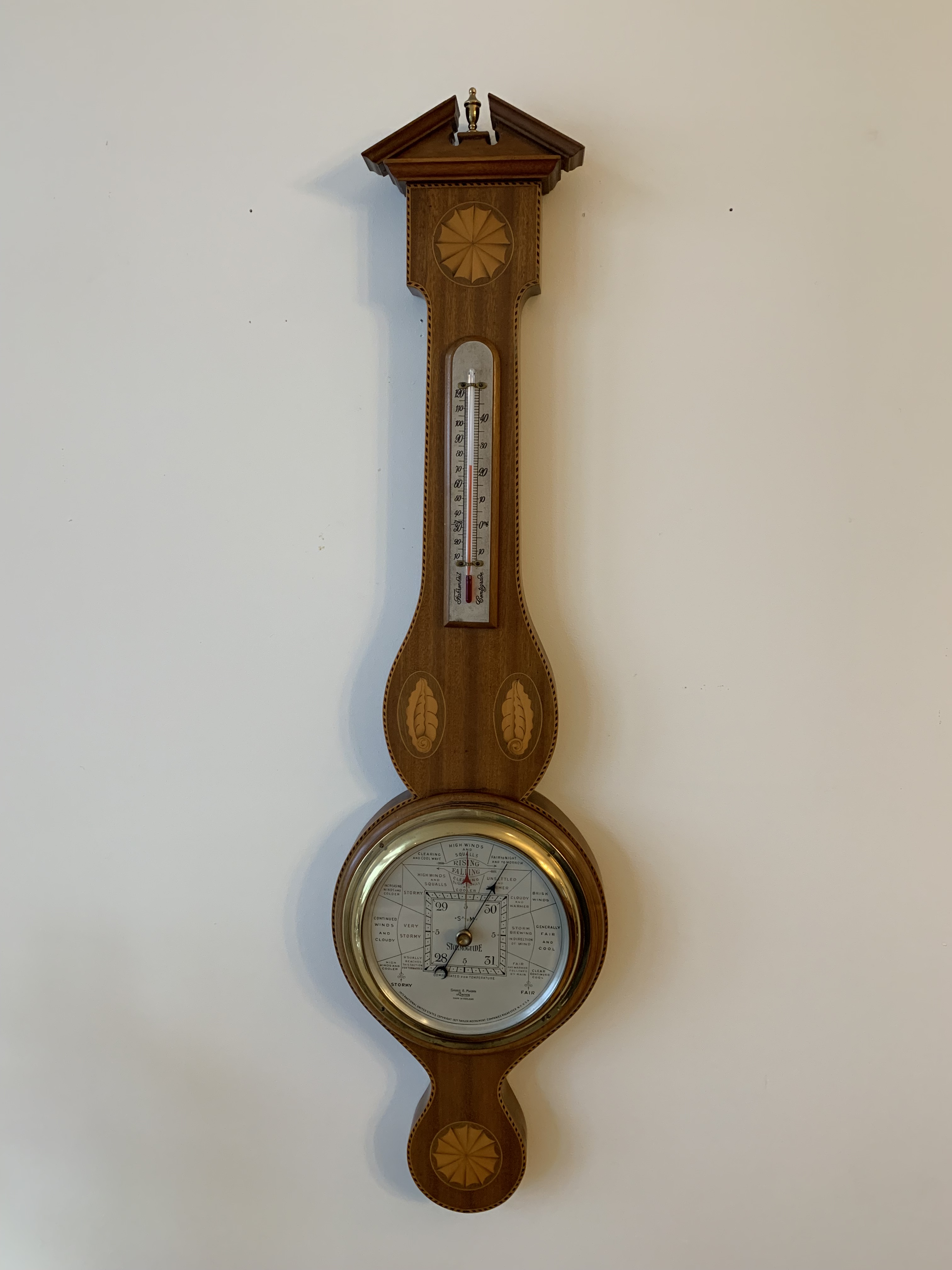
I remember the barometer hanging on the wall going up to the den in my grandparent’s house. My grandfather would daily tap the glass to view which way the dial was moving to see if the pressure was rising or falling. I still do that. The Barometer is in excellent condition and manufactured in 1927. I found an exact duplicate on an auction site but no value as it was sold
Casper Mine, ‘Portrait of a Woodsman’
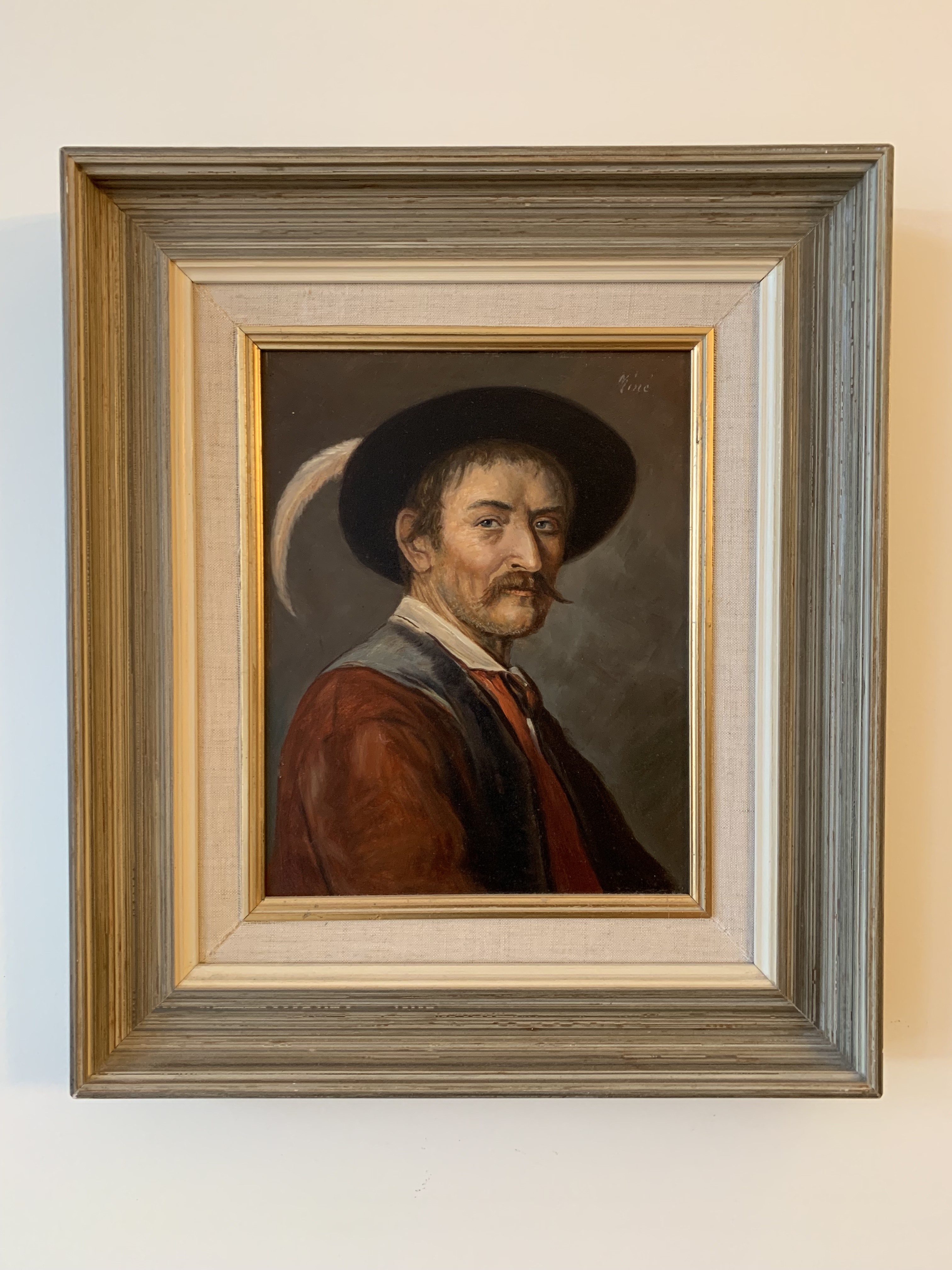
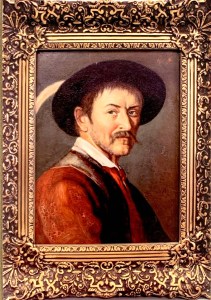
This is a small oil painting on Masonite of a woodsman. My grandmother bought the painting in Montreal in the 1940’s. She always was intrigued with the detail of the brush strokes showing the stubble of his beard. She also stated it was an original Mine.
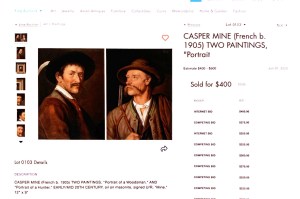
In 2020, I did a Google search and found Mine’s works. He painted many small portraits and the values where in the $100s.
Here’s the mystery- I found the exact painting currently for sale at an auction house! On close examination, the one for sale looked like it had more detail with the brush strokes. The only explanation I have is someone sold my grandmother a forgery without her knowing.
Roosters

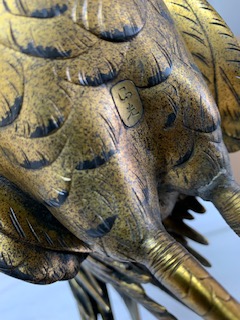
I don’t have information on the purchase or the significance of the Roosters other than I remembered them since they moved into 240 Stanley Drive in the 1950’s. Nothing was spoken about the value of them and when Grandmother Duretta sold her house, my dad spoke for them with the intentions of giving them to me. I then have passed them on to my son, Steve. In 2021, I did a Google search and found the significance of the art piece. They are artifacts from the Japanese Meiji Age which was from 1868 to 1912. I found the Japanese signature under the breast of the largest rooster.
Antique Japanese okimono gilt bronze rooster crafted in the shokado method of casting comprised of bronze, gold, and silver. The cockerel’s feathered body is finely chased and carved, delineating each feather with gilding and blackened patinated silver this is infused into the finish. Detailed gilt feet, beak, and eyes using the same technique except the red lacquered Comb of the cockerel. The realism of the sculpture is a test to the Meiji period craftsmanship.
 The Wolfhards